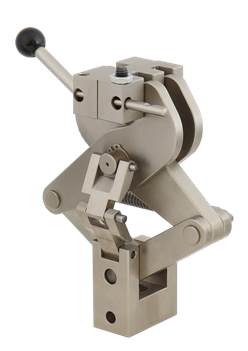


THS124
Glass bending fixtures
Glasbiegevorrichtungen
Specifications: According to EN1288
| Model | THS124 |
|---|---|
| Category | G02 – Bending Fixtures |
| Description | Glass bending fixtures |
| Beschreibung (DE) | Glasbiegevorrichtungen |
| Specifications | According to EN1288 |
4-Point Bending Test Fixture
Designed for determining the bending strength of flat glass according to DIN EN 1288-3 (test with specimen supported at two points).
The construction features a solid design to absorb the high breaking loads that occur during glass testing without deformation. Below is a detailed description of the components and their function within the scope of the standard.
Structure and Core Components
- Lower Bending Table (Support): The long base rail forms the foundation. Two adjustable support blocks are mounted on top of it. The engraved scale allows for exact, symmetrical adjustment of the support span (distance between the lower rollers). Two handles on the front facilitate the handling of the heavy metal rail.
- Upper Bending Punch (Load Application): The shorter upper assembly features a central connecting pin with a flange, through which it is coupled to the crosshead of a materials testing machine. Two adjustable blocks with a scale are also mounted here to determine the exact position of the load application points (bending span).
- Spring-Loaded Test Rollers: Both the lower support rollers and the upper pressure rollers are designed as solid steel cylinders. A crucial detail is the lateral tension springs that hold the rollers to the blocks. This suspension ensures that the rollers can adapt to the deflection of the glass specimen during the bending process and rotate freely around their longitudinal axis.
Operating Principle according to EN 1288-3
In the test according to Part 3 of the standard, the glass is tested in a 4-point bending test. The specimen rests on the two lower rollers, while the testing machine presses the upper two rollers onto the glass from above.
The fixture fulfills important normative requirements:
- Friction Minimization: The freely rotating, spring-loaded rollers virtually eliminate horizontal friction forces during the deflection of the glass. If the rollers were to jam, constraint stresses would arise, which would falsify the measurement results.
- Constant Bending Moment: The four contact points create a constant, maximum bending moment in the area between the two upper pressure rollers. Ideally, the glass breaks in this zone, allowing for a reliable calculation of the bending strength.
- Flexibility: The infinitely adjustable blocks allow different specimen dimensions and spans to be configured in accordance with the standard.